Benchmarks — the 9-shell race
Every number on this page is measured, not asserted, and reproducible with one command. Fairness rules and the measurement traps this harness has already fallen into are documented in
bench/METHODOLOGY.md.
We build hellish plus a zoo of real shells — bash, dash, zsh, mksh, ksh,
yash, busybox ash, fish — into one Docker image and race all nine on 17
portable POSIX workloads (make agnostic-bench). Ranking is the geometric
mean of the best-of-7 time on each workload, so no single benchmark can skew
it and warm-up noise is thrown away.
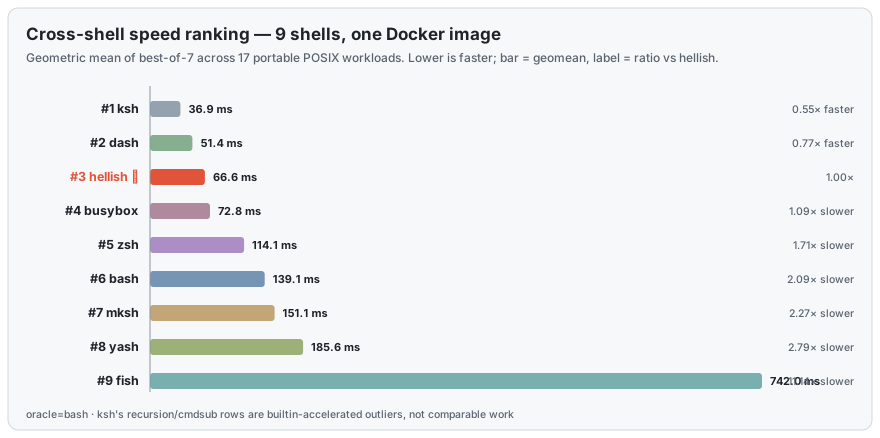
hellish ranks #3 of 9
| # | shell | geomean | vs hellish | |
|---|---|---|---|---|
| 1 | ksh | 36.9 ms | 0.55× | builtin-accelerated ¹ |
| 2 | dash | 51.4 ms | 0.77× | the minimalist speed king |
| 3 | hellish | 66.6 ms | 1.00× | ◀ us |
| 4 | busybox ash | 72.8 ms | 1.09× | |
| 5 | zsh | 114.1 ms | 1.71× | hellish is 1.7× faster |
| 6 | bash | 139.1 ms | 2.09× | hellish is 2.1× faster |
| 7 | mksh | 151.1 ms | 2.27× | |
| 8 | yash | 185.6 ms | 2.79× | |
| 9 | fish | 742.0 ms | 11.14× |
The honest summary: hellish is faster than 6 of the 8 other shells —
including bash (2.1×) and every feature-rich shell (zsh, fish) — and lands
just behind the two shells built to be minimal and nothing else. And it does
this while carrying a bash-class feature surface those minimalist shells
don't have (arrays, [[ =~ ]], ${v/p/r}, process substitution, job control,
vi/emacs editing). That combination — minimalist speed, bash features — is the
whole point.
¹ ksh93's #1 is partly an artifact: its recursion (
fib1854.6 ms vs everyone else's 2.4–4.8 seconds) and command-substitution rows are orders of magnitude off the field because ksh compiles/forklessly accelerates them — not comparable work. On the ordinary workloads it and hellish trade blows.
Where hellish wins, ties, and loses
No cherry-picking. Per-workload, best-of-7, lower is faster:
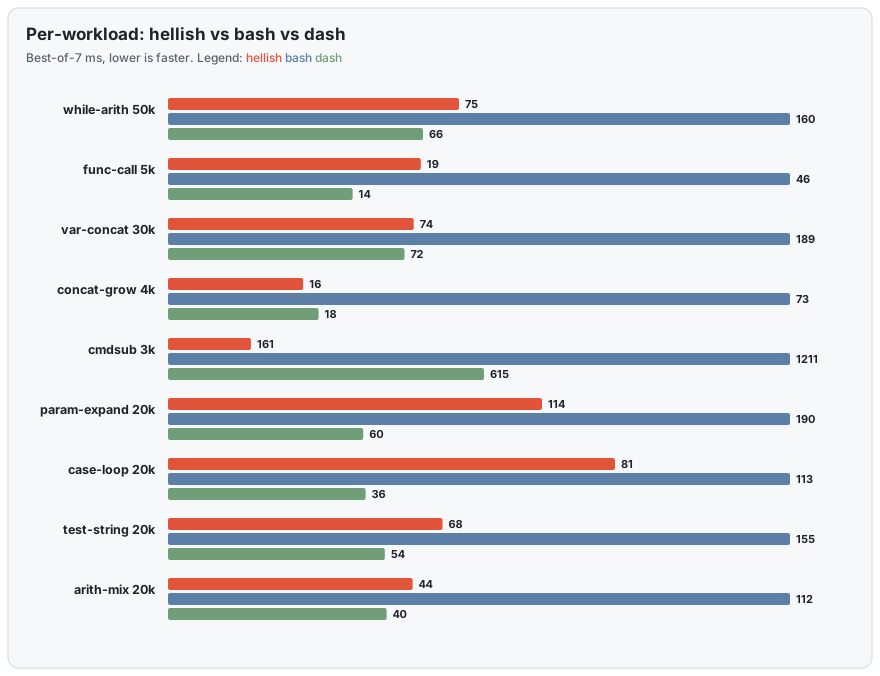
vs bash — hellish wins nearly everywhere it's tested:
| area | hellish | bash | verdict |
|---|---|---|---|
| arithmetic loops | 75 ms | 161 ms | ✅ 2.1× faster |
| string concat (grow) | 16 ms | 73 ms | ✅ 4.6× faster |
| variable concat | 75 ms | 189 ms | ✅ 2.5× faster |
| command substitution | 161 ms | 1211 ms | ✅ 7.5× faster |
test/[ ] string ops |
69 ms | 155 ms | ✅ 2.3× faster |
| function calls | 19 ms | 47 ms | ✅ 2.5× faster |
| parse a 50k-line script | 55 ms | 75 ms | ✅ 1.4× faster |
vs dash — the honest losses. dash is a tiny POSIX-only shell; matching it
is the goal, not always reached:
| area | hellish | dash | verdict |
|---|---|---|---|
| arithmetic loops | 75 ms | 66 ms | ≈ within 15% |
| command substitution | 161 ms | 615 ms | ✅ 3.8× faster |
read loop |
125 ms | 724 ms | ✅ 5.8× faster |
| function calls | 19 ms | 14 ms | ➖ dash faster |
| parameter expansion | 114 ms | 60 ms | ➖ dash faster |
| parse a 50k-line script | 55 ms | 29 ms | ➖ dash faster |
So: hellish beats dash on the fork- and I/O-heavy work (command substitution, read loops) and trails it on the pure-parse and pure-expansion micro-loops, where dash's do-almost-nothing design is hard to beat.
Memory
Peak resident set, median of 7 runs (make rss). hellish keeps a flat ~4 MB
working set on loops — competitive with bash, sometimes tighter — and pays for
its richer parser only where it parses a lot:
| workload | hellish | bash | dash |
|---|---|---|---|
| startup | 3.9 MB | 3.8 MB | 2.2 MB |
| arith loop | 3.8 MB | 3.9 MB | 2.2 MB |
| string concat | 3.9 MB | 4.1 MB | 2.2 MB |
| read loop | 3.9 MB | 3.9 MB | 2.2 MB |
| parse 50k lines | 11.6 MB | 4.9 MB | 2.2 MB |
The parse-50k line is our one real memory cost: the lexer materialises the
whole file's tokens up front. It's down from 158 MB → 20 MB → 11.6 MB over
successive rounds (8-byte deque tokens, a borrowed input buffer); the remaining
gap to bash is documented and the pull-lexer that closes it is planned in
backlog.md.
Conformance — more POSIX than dash
Two independent third-party suites, run against bash --posix and dash
(make conformance). hellish's rate is deliberately conservative — the Oils
harness credits a "known-ok" annotation that exists for bash/dash but cannot
exist for a shell it's never heard of, so we only ever count a hard pass.
mksh check.t (the ksh regression suite) — hellish now beats dash:
| shell | passed |
|---|---|
| bash | 292 |
| hellish | 218 🎉 |
| dash | 216 |
Oils spec suite (1622 cases spanning bash + POSIX features):
| shell | hard passes | pass-rate |
|---|---|---|
| bash --posix | 1311 | 85.1% |
| dash | 977 | 68.5% |
| hellish --posix | 1071 | 66.0% ᶜᵒⁿˢᵉʳᵛᵃᵗⁱᵛᵉ |
hellish sits between dash and bash on raw Oils count — but Oils tests a pile of bash-isms dash simply lacks, so on the shared POSIX core hellish is much closer to bash than the headline number suggests, and it already passes more of the ksh suite than dash does.
So where does hellish rank, today?
| dimension | tier | who's ahead |
|---|---|---|
| Speed | 🥉 top-3 of 9 | only ksh & dash (both minimalist specialists) |
| vs bash specifically | ✅ faster | hellish wins ~2× on the geomean |
| Features | high | far beyond dash/busybox/mksh; near bash/zsh |
| Memory | good | flat ~4 MB; heavier only on big parses |
| POSIX conformance | solid | ahead of dash on mksh, behind bash overall |
The one-line placement: hellish is a top-tier-fast shell that behaves like bash. Nothing else in the field pairs dash-adjacent speed with bash-class features — the minimalist shells (dash, busybox, mksh) are fast but bare, and the featureful ones (bash, zsh, fish) are slower. hellish sits in the empty quadrant between them.
Reproduce it
make agnostic-bench     # the 9-shell Docker race (needs docker; installs the shells for you)
make rss conformance    # memory + the two conformance suites
make charts             # redraw every SVG on this page from the raw artifacts
See also: Performance & Robustness · Architecture